QTc & JTc Calculator
Rate-correct the QT and JT intervals with Bazett, Fridericia, Framingham, and Hodges.
Enter heart rate or RR — the other fills in automatically.
Enter a QT interval and a heart rate or RR interval to see results.
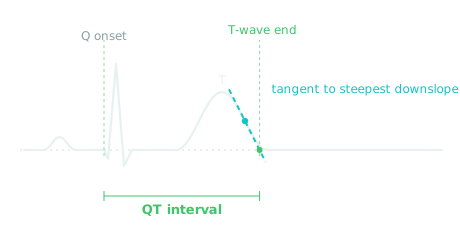
Measure QT from QRS onset to the end of the T wave. By the tangent method, extend a line along the steepest downslope of the T wave to the isoelectric (TP) baseline — the intersection marks the T-wave end. Exclude a distinct U wave; leads II and V5 are preferred. Method and reference ranges per Rautaharju PM, Surawicz B, Gettes LS. AHA/ACCF/HRS Recommendations for the Standardization and Interpretation of the ECG, Part IV. Circulation. 2009;119:e241–e250.
QTc reference ranges · AHA/ACCF/HRS 2009
| Status | Category | Male | Female |
|---|---|---|---|
| Normal | Normal | < 450 ms | < 460 ms |
| Prolonged | Prolonged | ≥ 450 ms | ≥ 460 ms |
| Markedly prolonged | Markedly prolonged | ≥ 500 ms (torsades risk) | |
| Short | Short | ≤ 390 ms (either sex) | |
JTc is computed as QTc − QRS. Bazett: QT ÷ √(RRs); Fridericia: QT ÷ RRs1/3; Framingham: QT + 154·(1 − RRs); Hodges: QT + 1.75·(HR − 60), where RRs = RR in seconds. Interpretation follows the AHA/ACCF/HRS 2009 standardization statement — prolonged QTc ≥ 450 ms (men) or ≥ 460 ms (women), short ≤ 390 ms — applied to the Bazett QTc; ≥ 500 ms is markedly prolonged (torsades-de-pointes risk). For informational and educational use. Do not use this calculator as the sole basis for patient-care decisions; confirm measurements against the tracing and follow applicable clinical guidance.